
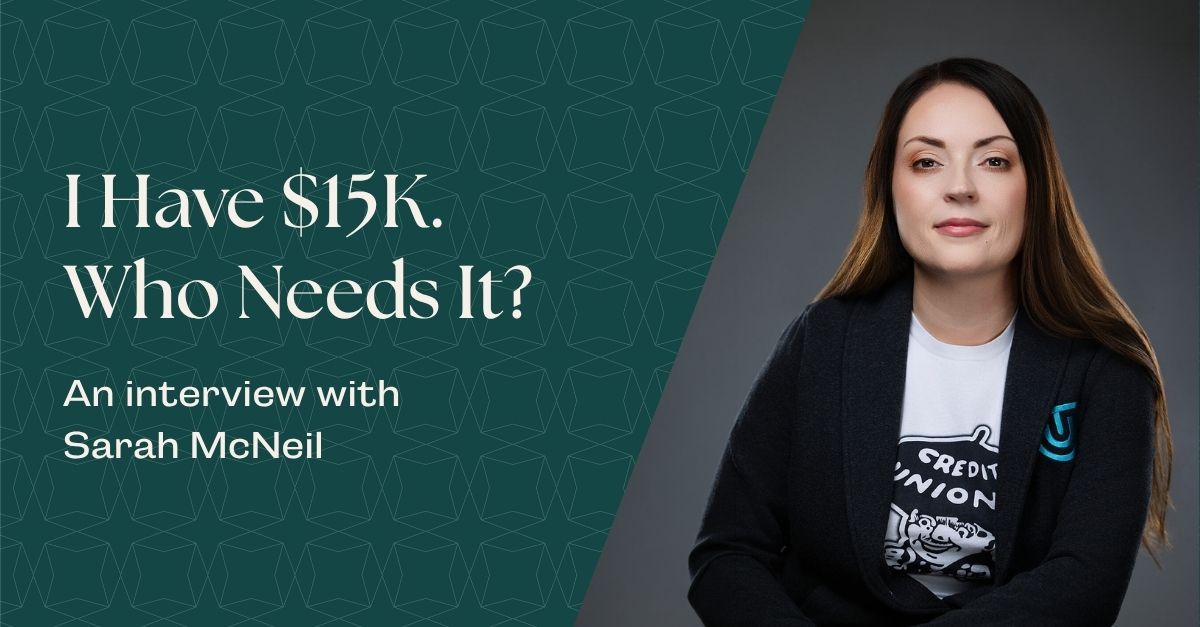
Sarah McNeil is asking what really makes credit unions different
Credit unions spend a lot of time explaining what makes them different from banks.
They point to member ownership, lower fees, and better rates. Those things matter. But Sarah McNeil, CEO of United Trades Federal Credit Union in Tualatin, Oregon, thinks the answer has to go deeper than that.
“I think it’s proximity,” she says. “The ability to know our members well enough to see problems others miss and solve problems others won’t.”
Most members don’t know they are owners, she argues. The ones who do rarely feel it. Proximity is where that starts to change.
For Sarah, that belief is not theoretical. It started at a kitchen table.
The Kitchen Table
Sarah grew up around credit unions. Her mother worked at Payless Credit Union in Portland, but it was never just where she worked.
She recalls an evening when her mother brought Sarah and her sister along after work to visit a member at home. While the girls played with the family’s kids, her mother sat down at the kitchen table and spent time teaching the member how to read, and how to understand their statements.
Sarah was five, maybe six years old. “I knew what she was doing was kind,” she says. “I was learning to read myself in school. I understood what was happening.”
She understood something else too. Financial services could be about more than numbers. It could be about sitting down with someone and helping them do something hard.
Years later, when people ask what makes a credit union different, she still thinks about that kitchen table.
The Union Hall
United Trades’ branch is not in a commercial district or a shopping center. It is inside the United Association Local 290 union hall.
That is not a marketing decision. It is a statement about who the credit union exists for.
Its members are skilled tradespeople, primarily plumbers and pipefitters. Some have worked for the same employer for years. Others move between job sites and projects. Members describe the work as feast or famine: months of overtime, then a project ends and the work disappears.
When the region’s construction market slows, it does not slow evenly. But for the members it does reach, the impact can be immediate. A paycheck that existed last week may not exist next week.
A conventional financial institution sees income volatility and calls it risk. United Trades sees the same thing and calls it the membership.
That difference matters to Sarah. “When you know the people behind the numbers, you start asking different questions,” she says.
And during one of the worst slowdowns in more than a decade, those questions became urgent.
Who Needs It?
Earlier this year, members were already using skip payments and emergency loans. United Trades had also created Solidarity Link, a way to direct surplus back to members experiencing hardship.
The tools were there, but the credit union still had a decent bottom line.
Sarah thought about what that meant. The surplus belonged to the members. Some of those members were struggling. The math was not complicated.
So she went to union leadership with a simple question. “I have $15,000. Who needs it most?”
The answer was the apprentices. They could not travel to other locals for work the way journeymen could. Some had been out for months.
United Trades divided the money, $185 each. They sent word to all 81 apprentices: no application, no conditions, no expectation of anything in return. Fifty-six accepted.
Gas tanks. Utility bills. One less thing to worry about.
“We genuinely went in just wanting to get money into their hands,” she says. “That’s it.”
The Cooperative Question
When United Trades distributed that money, people treated it as unusual. Sarah never understood why. It was not charity, or a campaign. She argues, the cooperative model isn’t just a philosophy. It has evidence behind it.
“Political scientist Elinor Ostrom spent her career studying how communities solve problems together through shared governance,” she says. “Her work suggests that communities can achieve the benefits of efficiency through cooperation rather than consolidation. She won the Nobel Prize for that work.”
Yet, when credit unions face pressure today, the conversation often turns to consolidation. Fewer institutions. Bigger balance sheets. More scale.
Sarah is not arguing that every credit union should survive forever. She knows the pressures are real. However, she worries the movement has become too quick to accept consolidation as the only serious answer.
So she asks a different question.
“If cooperation is our superpower, why does the movement so often choose consolidation before deeper cooperation?”
What We Choose to Practice
The kitchen table. The union hall. The apprentices.
For Sarah, these are not separate stories. They are all evidence of the same belief: credit unions are at their best when they stay close enough to know what their members need and brave enough to act on it. That is the conviction driving her work at United Trades and her advocacy for small, mission-driven credit unions.
“I’m not saying that we should go back to the past. I’m asking if we’ve been innovative enough in how we cooperate. Member to member and credit union to credit union,” she says. “If cooperation is what makes credit unions different, it should be more than a principle. It should be a strategy.”
Sometimes, it sounds as simple as walking into a union hall and asking:
“I have $15,000. Who needs it?”
Sarah McNeil is the CEO of United Trades Federal Credit Union in Tualatin, Oregon, and a member of CUWLA.